Opening and Locking a User Record
Opening a user record means looking at it: click a researcher anywhere their username appears — a search result, the Signed In Users panel on the dashboard, a request, or an appointment — and their record opens. Anyone with permission to view users can open a record to read it. Opening alone changes nothing and never blocks a coworker.
Locking is what happens when you start editing a record. Aeon uses a real-time lock so that only one staff member edits a given user at a time. The lock is what stops two people from overwriting each other's changes on the same record. Most of the time you never think about it: the moment you change a field, Aeon locks the record for you automatically. The Lock button and the warnings on this page are there for the cases where you want to claim a record deliberately, or where someone else already has it.
- You start editing a user's details — Aeon locks the record for you automatically; you don't have to do anything.
- You want to claim a record before editing it, so coworkers see it's taken — click Lock.
- You open a record and see Locked by someone — that tells you to coordinate rather than overwrite.
Opening a user record
You can open a record from anywhere a username appears:
- Find the user — run a user search, click a researcher in the Signed In Users panel on the dashboard, or follow a username link from a request or appointment.
- The user record opens, showing the Detail section and tabs across the form (Notes, Requests, Appointments, History, Emails, Proxies, Billing, Attachments, and so on), plus the action toolbar.
- Read or review freely. While you're only viewing, the record is not locked and stays available to everyone.
The browser URL updates to the user (for example, /users/jsmith), so you can copy the address to share the exact record with a colleague. You can jump straight to a tab with its own address too — for example, /users/jsmith?tab=requests.
Opening a record loads it read-only until you actually change something. You can open #12345's requester to check their details mid-task and nothing about the record changes.
How locking works
The lock is shown by a single control in the toolbar that changes depending on the current state:
| Toolbar control | What it means |
|---|---|
| Lock (open-padlock icon) | The record is free. Click to claim it for editing. |
| Unlock (padlock icon, amber) | You hold the lock. Click to release it. |
| Locked by name (padlock icon, red, disabled) | Someone else is editing it right now. You can't edit until they release it. |
Hovering the control shows a tooltip — "Lock this user for exclusive editing," "Release your lock on this user," or "This user is being processed by name."
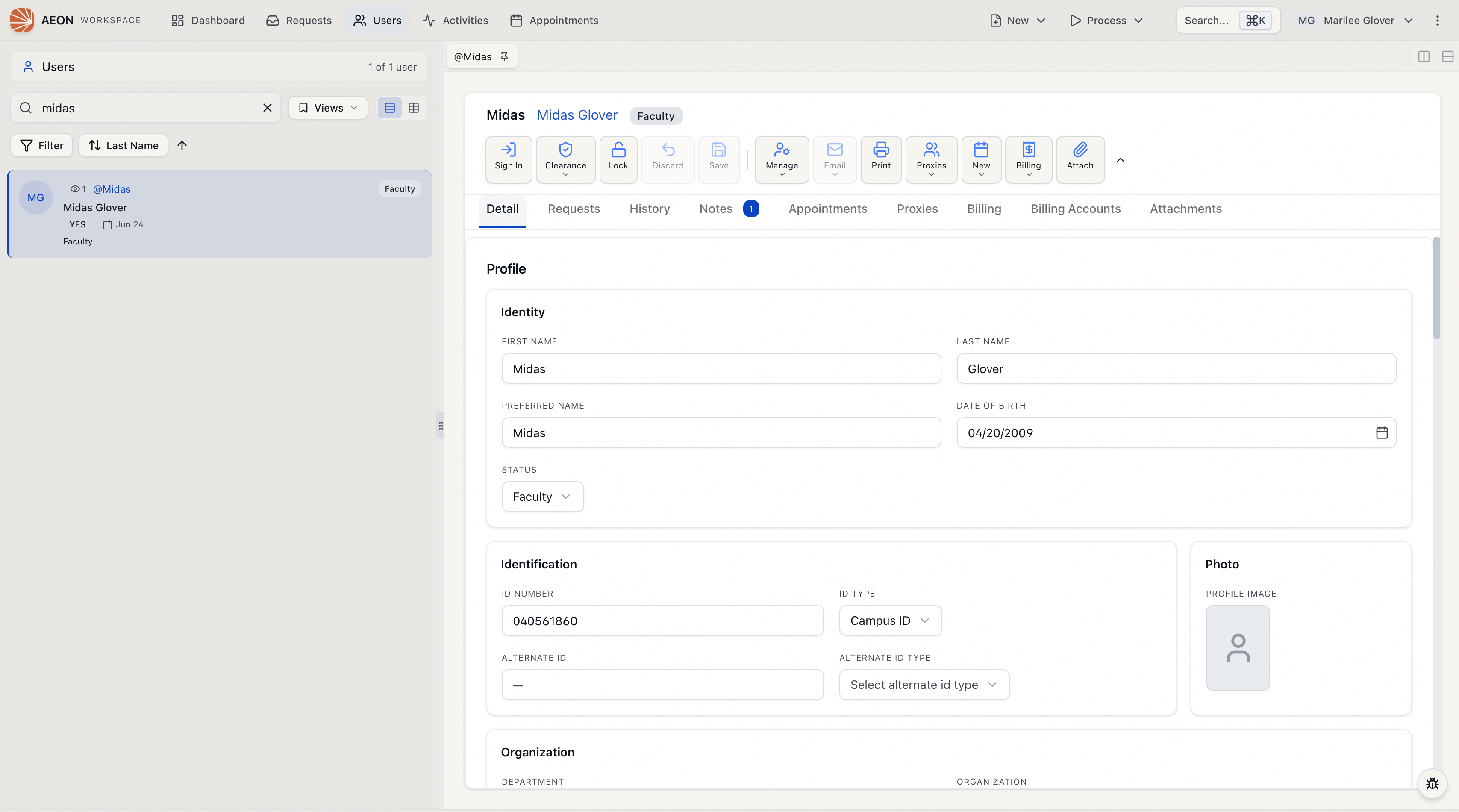
Locking happens automatically when you edit
You rarely click Lock yourself. The moment you change any field on a user record, Aeon acquires the lock for you in the background. From that point the record is yours until you save, discard, release it, or lock a different record.
Locking manually
To claim a record before you start typing — useful when you want coworkers to see it's taken:
- Open the user record (for example, jsmith).
- In the toolbar, click Lock.
- The control switches to Unlock (amber), and a brief "User locked for editing" confirmation appears.
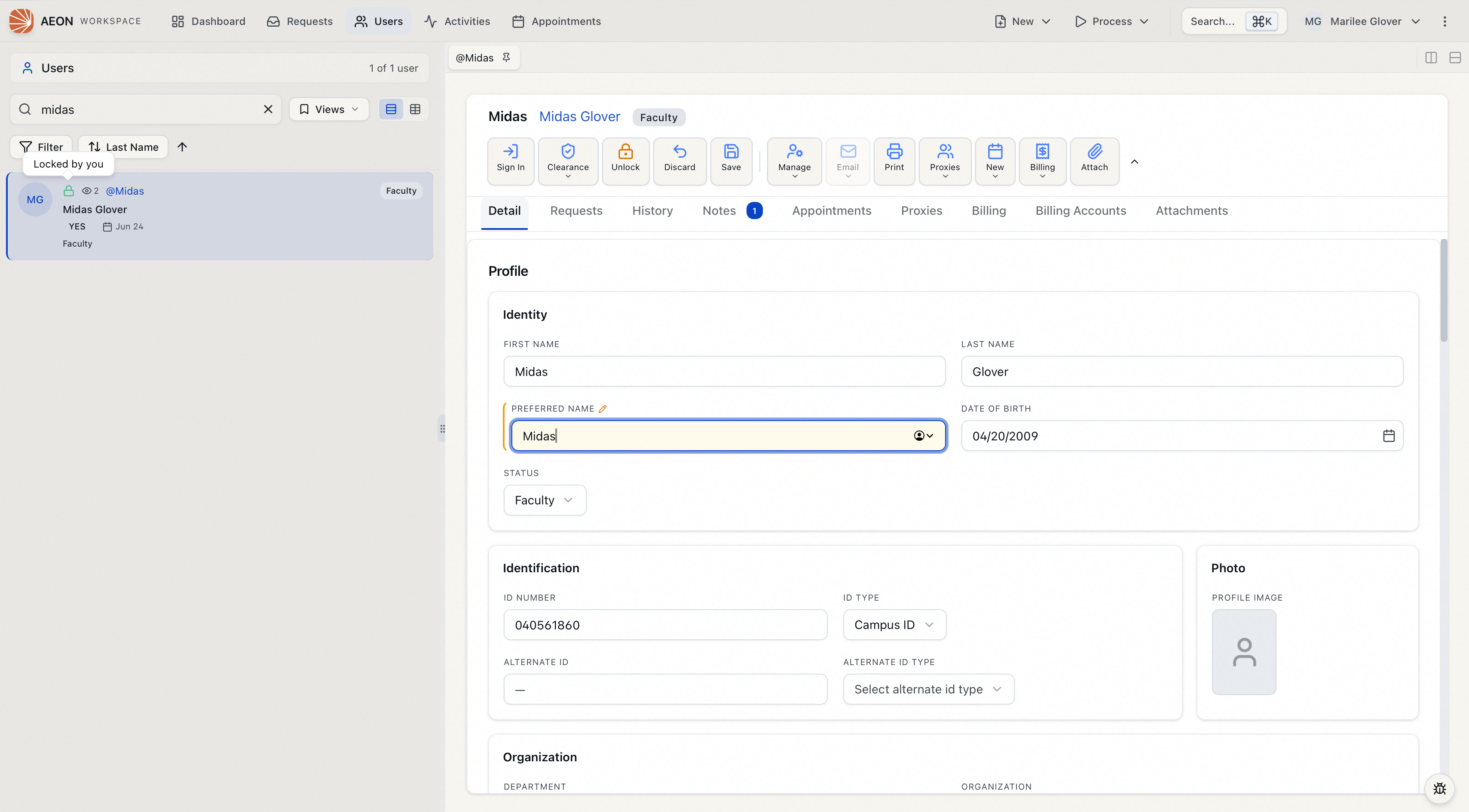
Releasing the lock
Your lock is released when you:
- click Unlock (you'll see "User unlocked"),
- Save your changes — saving releases the lock automatically,
- Discard your changes,
- lock a different record — you can only hold one lock at a time, so locking another record automatically releases this one, or
- let it time out from inactivity (see below).
Simply viewing another user, request, or activity does not release your lock — you can look something up and come back. The lock only moves when you actually lock a different record. This lets you reference other records mid-edit without losing your place.
When someone else holds the lock
If you open a record a coworker is editing, the toolbar shows Locked by name and the form is read-only. You can still read every field and tab; you just can't edit or save until they're done. The toolbar's editing actions — Save, Discard, the clearance and reading-room buttons, and the Manage/Email/Proxies/New/Billing menus — are all disabled while someone else holds the lock.
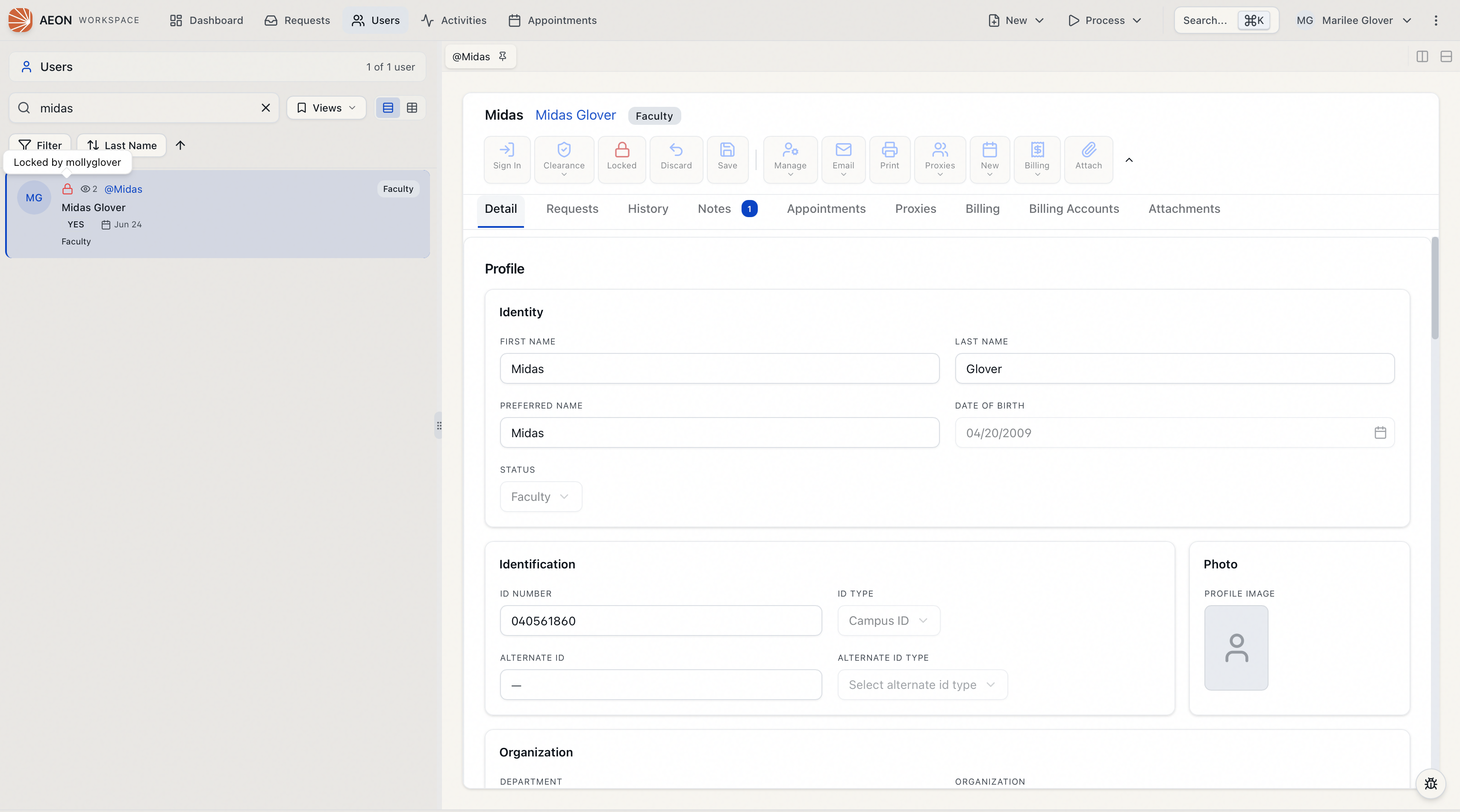
While a record is Locked by another user, editing is disabled. If you try to save anyway, Aeon refuses with "Cannot save - this user is locked by another user." Reach out to the person named on the lock instead of forcing the change. The moment they release it, the control returns to Lock and the record is yours to claim.
If someone takes a lock on a record you're viewing, Aeon tells you in the moment with a "User is now being edited by name" notification, so you know to stop before making edits.
Lock timeout — what happens if you walk away
A lock is meant for active work, so Aeon won't let an idle lock block a record forever. If there's no activity on your locked record for several minutes, Aeon eventually releases the lock automatically so a coworker can take it. As long as you're actively editing, the lock refreshes on its own and you'll never run into the timeout.
If the lock does expire, Aeon shows "Your lock on this user has expired." Reopen the record and click Lock (or just start editing again) to claim it once more.
Separately, if your browser loses its connection entirely — you close the tab, your laptop sleeps, or the network drops — Aeon releases your locks automatically after a brief grace period, so a dropped session doesn't leave a record stuck.
- You need the View level of the Users permission to open a record at all. If your role can't view users, the record won't open.
- The Lock/Unlock control, and editing in general, require the Edit level of the Users permission. If your role is view-only for users, the form is read-only and the Lock control is disabled.
- Locking relies on Aeon's real-time connection. If your session has lost that connection (for example, after a network drop), the Lock control is temporarily disabled until it reconnects.